Hand-Drawn, With Proof: Why Brands and Licensors Are Asking for Human-Made Art
AI can now produce a beautiful illustration in a few seconds, and manga drawn entirely with AI have already been published. What AI still cannot do, we believe, is create the truly original worlds and stories that the best manga and anime are known for.
But even if AI images become technically as good as human ones, that does not settle the matter. For work that carries a brand, a licence or a price tag, such as a product, a character, a book cover or a collectible, the question of how an image was made has become a commercial question, not only an artistic one.
Some clients now ask us directly for “proof of humanity”: evidence that a real artist drew the work by hand. Here is why, and what that proof looks like in practice.
1. You cannot fully own what a machine made
For most commercial work, the artwork is an asset. A brand wants to own its character. A licensee wants to protect its product from copies. That ownership depends on copyright, and copyright depends on a human author.
In the United States, the Copyright Office stated in January 2025 that copyright “does not protect output that is wholly generated by AI models,” and that “prompting alone does not qualify as sufficient human authorship.” Only the human contribution, such as original changes or arrangement, can be protected. In March 2025, a federal appeals court confirmed in Thaler v. Perlmutter that “human authorship is a bedrock requirement” for copyright.
In practice, this means a character or a product design made mainly with AI may be difficult to protect. A competitor could copy it, and there would be little the owner could do.
2. Rules and contracts now ask the question
Since 2 August 2026, the EU AI Act requires providers of generative AI tools to mark their output as AI-generated in a machine-readable way, and requires AI-generated content that realistically depicts real people to be disclosed. Many AI image tools now embed these markers automatically.
Licensors and brand owners are following the same direction. More and more contracts ask suppliers to confirm whether AI was used, or exclude it entirely. For licensed products that show real people, such as athletes or celebrities, the question is even more sensitive.
3. Audiences care
Customers, collectors and readers pay close attention to how the work they see is made, and the reaction to AI can be fast and public. In December 2025, McDonald’s Netherlands released a Christmas advert made entirely with generative AI. After a wave of criticism online, the company took it down three days later, calling the episode “an important learning” in its use of AI.
For a brand, the cost of that kind of story is far higher than the saving on production.
What proof looks like
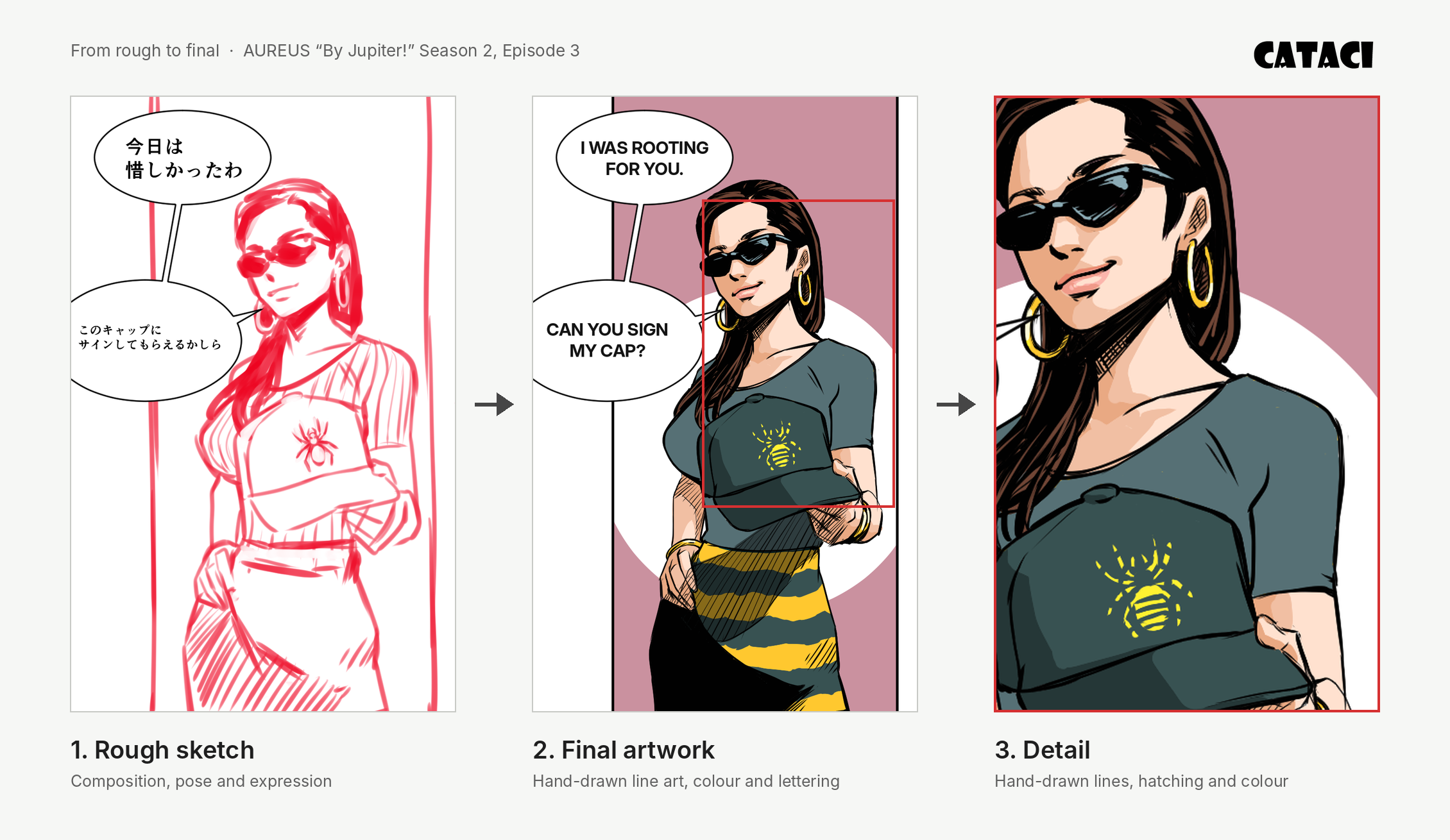
A finished image alone cannot prove how it was made. The proof is in the process. Hand-drawn work leaves a trail that AI-generated images do not: rough sketches, line art, colour stages and layered working files.
At CATACI, our manga and illustration artwork is drawn entirely by hand, on paper or with digital pens and brushes. We do not use generative AI to create it. We use modern digital tools throughout, from digital inking and colouring to online review, but every line of the artwork is drawn by a person. Every project goes through the same visible stages:
- Rough sketch. Composition, poses and expressions, shared for your feedback before any detailed work begins.
- Line art. The final drawing, refined from the approved sketch.
- Colour or tones. Applied in layers, so changes stay precise and quick.
- Final files. High-resolution artwork, with layered source files where the project requires them.
On request, we document each stage for the client, with work-in-progress files and screenshots of the drawing process. That record shows exactly who made the work, and it supports a clean chain of rights from the artist to CATACI to the client.
For clients who want an original on paper, our artists can also ink the line work by hand, so the client receives physical artwork as well as the digital files.
Human-made is becoming a mark of quality
AI will keep changing how images are made, and for some uses it will be good enough. But for work that carries a brand, a licence or a collector’s expectations, the value is moving in the other direction. Clients want to know who made the work, and they want to be able to prove it.
For manga and anime, our core work, we are even more confident that the heart of production will stay human. In anime, new tools, including AI, will likely speed up parts of production. But the story, the characters and the key artwork will still come from people, because truly original, powerful storytelling needs human creativity.
There is another reason, and it matters even more: in the end, we love what people make. We want to know who is behind the work, what kind of person they are, how they have lived and what they have been through.
Recently, I watched The Boy and the Heron with my 15-year-old son. He grew up in Sweden, and he knew Hayao Miyazaki’s name, but not much more. After the film, he found a documentary about how Miyazaki came out of retirement to make it. He was fascinated, and knowing the story behind the film made it even more memorable for him.
That is what a human creator adds. In our projects, especially manga and anime storytelling, the artwork is not decoration added to a product. It is the heart of the work. Every page and every character is drawn by a person with their own life, experiences and passions, and that is exactly why people want to know who made it.
That is the kind of work we do. If you are planning a character, a campaign, a book or a licensed product and need hand-drawn Japanese manga or illustration with a documented process, we would be glad to hear about it.
Contact us: cataci.com/en/contact